A small business owner hires a designer, spends a few thousand dollars on a beautiful new website, and then waits for the phone to ring. Weeks pass. Traffic stays flat. Google still shows competitors above them. The site looks professional, but it might as well be invisible.
At PalmTec, we frequently see this same scenario: a website built for aesthetics without a single SEO consideration baked into the build. When SEO and web design aren't treated as connected disciplines from the start, even the most polished site stays buried in search results.
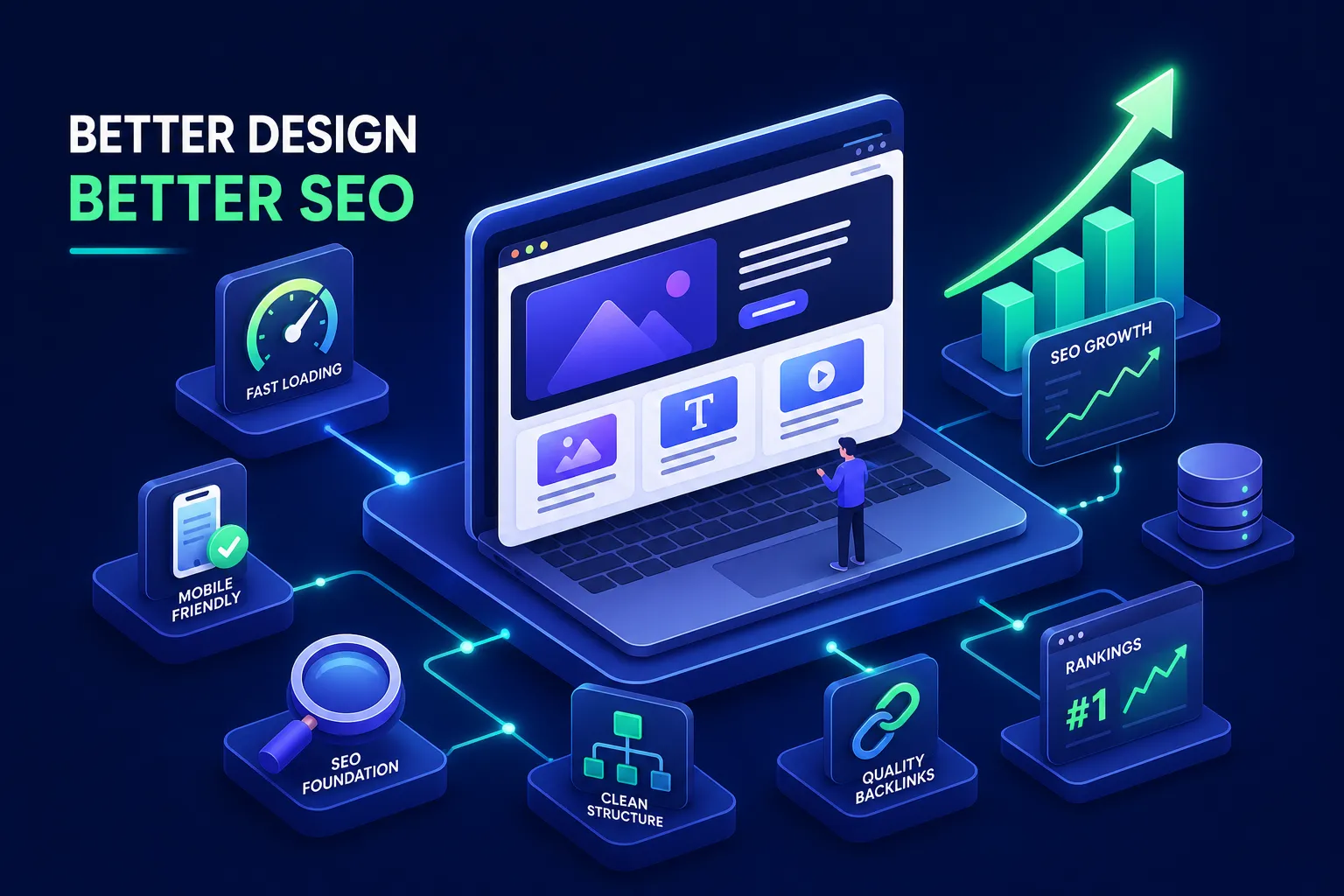
The core problem is how people think about these two disciplines. Web design and SEO get treated as separate projects, different budgets, different timelines, different teams. In reality, design decisions like URL structure, heading tags, image sizes, page layout, and schema markup all affect how Google finds, reads, and ranks your site. Those are also ranking factors. Build them wrong and you pay twice: once to build the site and again to fix it.
Here are seven concrete ways that good web design directly improves your search performance, from site structure to structured data.
How SEO and Web Design Shape Site Structure
Google's crawlers navigate your site by following links. The way your pages connect to each other determines what gets discovered, how frequently it gets crawled, and how much authority it accumulates. A flat, logical site hierarchy keeps every important page reachable within three clicks of the homepage. That proximity signals to Google that the page is important, which increases crawl frequency and indexing priority. Deeply nested structures do the opposite.
When a valuable service page is buried five levels down with no internal links pointing to it, Google finds it rarely, if ever. That's not an SEO problem you can fix with a plugin. It's a structural design decision that has to be corrected at the architecture level. For a practical primer on how search engines determine what to index and how pages are discovered, see this indexability guide.
Way 1: Clean URL hierarchy that mirrors your content
A URL like /services/web-design gives Google immediate context about what a page covers. A URL like /page?id=42 gives it nothing. Descriptive, keyword-relevant URLs organized into logical categories signal content hierarchy to both search engines and users. The critical point here is timing: URL structure needs to be planned before development begins, not cleaned up after launch when redirects become necessary. Follow established URL structure best practices from Google when mapping your site to avoid costly redirects later.
Way 2: Internal linking as a crawl-friendly roadmap
The hub-and-spoke model works simply: your most important pages sit at the center, and related content pages link back to them. Pages that receive more internal links get treated as more important by Google. Orphan pages with no internal links pointing to them get overlooked entirely, regardless of how good the content is. Your page layouts and calls to action directly shape this internal link structure, which means your designer is making SEO decisions whether they realize it or not.
Page Speed: A Core SEO and Web Design Concern
Google officially uses Core Web Vitals as a ranking factor, and this is where the connection between SEO and web design becomes the most measurable. Your developer's choices about image compression, font loading, animation libraries, and CSS weight have a direct and documented impact on organic rankings. Industry research, including Google's own studies on mobile performance, consistently shows that even a one-second delay in page load time can meaningfully reduce conversion rates, while pages that cross the three-second threshold see significantly higher bounce rates. The exact impact varies by industry and audience, but the direction is always the same: slower pages rank lower and lose users faster.
Google evaluates these thresholds at the 75th percentile of real user data, meaning your slowest visitors set the bar. Speed is a specific, measurable commitment, not a vague performance goal. Learn the benchmarks that matter by reviewing the official Core Web Vitals metrics.
Way 3: Core Web Vitals scores that Google uses to rank your site
The three metrics you need to hit are Largest Contentful Paint (LCP) under 2.5 seconds, Interaction to Next Paint (INP) under 200 milliseconds, and Cumulative Layout Shift (CLS) under 0.1. LCP measures how fast the largest visible element loads, typically your hero image or headline. INP measures how quickly the page responds to user interactions like clicks and taps. CLS measures how much the layout shifts while the page loads.
Each metric ties directly to design decisions. Your hero image file size affects LCP. JavaScript weight affects INP. Loading ads or web fonts without reserved space causes CLS. These aren't development afterthoughts, they're design-phase commitments.
Way 4: Lean code and optimized images prevent ranking drops
Theme bloat, uncompressed images, excessive plugins, and render-blocking scripts are all design-phase choices that tank load times after launch. Lazy loading, browser caching, and server-side rendering are practical solutions that need to be part of the build plan, not afterthoughts. Choosing a CMS platform and theme at the start of a project is itself an SEO decision. A poorly coded theme can add significant CSS and JavaScript payloads to every page load before you've added a single line of custom code, weight that compounds with every plugin and image you add later.
3. Mobile-first design is how Google decides where to rank you
Google indexes and ranks the mobile version of your website, not the desktop version. This has been the standard for several years and remains the default for all sites in 2026. A site that looks polished on a laptop but performs poorly on a phone will rank as a poor mobile experience, period. Poor mobile performance doesn't just push rankings down; it reduces your visibility across Google's index, since the mobile version is what Google's crawler actually evaluates. For a deeper look at why mobile-first indexing matters, review this article on mobile-first indexing.
Way 5: Responsive layouts, touch targets, and no layout shifts
Mobile-first SEO and web design requires fluid grids that eliminate horizontal scrolling, touch targets sized at a minimum of 44×44 pixels so buttons are tappable without frustration, and responsive images that serve appropriately sized files based on the viewer's screen. Intrusive pop-ups that block content on small screens carry a specific Google penalty. Google also recommends content parity between your mobile and desktop versions, if primary content is hidden behind interactions that Googlebot won't trigger, it's unlikely to be crawled or indexed. Mobile-first design and SEO are no longer two separate considerations. They're the same discipline.
4. How you structure content on the page shapes what Google understands
Architecture and speed are table stakes. What happens inside individual pages matters just as much to Google. Heading hierarchy, semantic HTML, image alt text, and anchor text are all visual content decisions that also function as ranking signals. A designer who understands this writes smarter briefs and produces pages that actually perform rather than just look good.
Way 6: Semantic HTML and heading hierarchy clarify your content to Google
H1 through H3 tags are not styling tools. Google reads them as a structured outline of your page content. A page with a clear H1, logical H2 section headers, and descriptive body copy communicates its topic clearly. A page built with styled divs and no semantic structure looks identical to users but significantly reduces Google's ability to interpret the page's topic and content hierarchy. This is what separates SEO-friendly web design from purely aesthetic work.
Three on-page signals that designers consistently overlook deserve direct attention. Image alt text is critical for both accessibility and image search visibility. Anchor text on internal links should describe the destination page ("our web design services"), not use generic phrases like "click here." And important text content should always be real HTML, not embedded in images or SVGs, because Google cannot reliably read text inside image files.
5. Structured data turns your design into rich search results
Schema markup is JSON-LD code added to a page that tells Google what the content means, not just what it says. A business hours section is just a list of times without schema. With LocalBusiness schema, it becomes a verified source that Google can display directly in search results. For small businesses, schema is one of the most underused SEO advantages available, and one of the easiest to implement at the design phase when the page structure is being built anyway.
Way 7: Schema markup types that directly increase search visibility
The most impactful schema types for small business sites are LocalBusiness (use the most specific subtype available, such as Plumber or LawFirm rather than the generic LocalBusiness), Service, FAQPage, and Article. FAQPage schema is particularly valuable: industry guidance suggests keeping answers between 40 and 60 words each, paired with question-style headers, to qualify for FAQ rich results in Google's search listings.
All structured data should be validated using Google's Rich Results Test before launch. This is a design-phase requirement, not a post-launch item. Once page content and layout are finalized, adding schema retroactively means another round of development work, extra time and cost that's easy to avoid when it's built into the process from the start. If you need implementation guidance specific to local businesses, this local schema markup reference offers useful examples and subtype recommendations.
Why handling design and SEO separately costs small businesses twice
When a web designer and an SEO consultant work independently, the SEO professional almost always discovers the same set of problems: wrong URL structure, no schema, poor heading hierarchy, a theme that tanks page speed. Fixing those issues means redirects, restructured navigation, and code-level changes to a site that was just built and launched. In our experience, businesses often find themselves facing a partial or full rebuild within 12 to 24 months of launch.
The rework cycle is predictable. A designer builds the site without SEO requirements in the brief. An audit reveals structural problems. A developer is called back in to fix redirects, restructure URLs, and clean up code. Each handoff adds cost and delay, and the site spends months in a ranking hole while the fixes are implemented. None of this is necessary when SEO requirements are written into the design brief from day one.
At PalmTec, SEO and web design are handled under one roof precisely because of this. Every decision, from URL mapping and heading structure to schema type selection and meta templates, is informed by search performance requirements starting at the first project kickoff. The process includes a built-in SEO planning checklist covering URL mapping, redirect logic, schema mapping, sitemap configuration, and meta templates. Small business owners don't need to coordinate separately between a designer, a developer, and an SEO consultant. The alignment is already built in. Learn more on our About PalmTec page.
Build it right the first time
SEO and web design are not independent disciplines. Site architecture, page speed, mobile responsiveness, content structure, and structured data are all design decisions that directly determine where your site ranks. The seven approaches covered here, from clean URL hierarchy and internal linking to Core Web Vitals, mobile-first layout, semantic HTML, and schema markup, form the foundation of any site that performs in search.
Whether you're building a new site or evaluating a redesign, run any vendor conversation through these criteria. If a designer can't speak to SEO requirements during the design conversation, the two will be misaligned after launch. That misalignment costs money to fix.
If you want SEO and web design handled together from the first wireframe to the final validation test, PalmTec's integrated design and SEO services are built for exactly that. Reach out and let's talk about what your site needs to actually rank.